
By Juste Thales Gnimavo (CEO, ZeroSuite) & Claude Opus 4.7 — web instance, Claude.ai
Two days ago, Web Claude almost talked me into shipping the wrong home page for Deblo.ai.
Not because the suggestions were bad. They were excellent — well-reasoned, well-written, well-structured. The copywriting pack alone was 705 lines of production-ready content. The drawer architecture was sound. The minimalist hero followed every best practice from ChatGPT, Gemini, Grok, and Claude.ai itself.
The problem is that all of those references are wrong for Deblo. And it took me two separate corrections — eight messages apart — to drag the conversation back to the position that actually matched my market.
This is the story of those two corrections, what Web Claude could not see on its own, and what every founder building with AI in 2026 needs to understand about the limits of strategic delegation.
It is also, in the second half, an honest disclosure about what serious AI-augmented product work actually looks like in 2026 — because there is a dangerous narrative spreading that says "you just talk to ChatGPT and code happens." That narrative is going to embarrass a lot of CEOs who hire developers expecting that experience.
Part 1 — The Setup
Deblo.ai is the AI tutor for African francophone students from CP to Terminale. We covered the architecture in depth in AI Tutoring for 250 Million African Students. The product runs in production. The voice agent is live. The mobile money payments work across six countries. There are real students using it daily.
The web home page, however, was confused.
It carried two products inside one URL: Deblo K12 (children) and Deblo Pro (accountants, lawyers, HR managers). It had an "Élèves / Professionnels" toggle visible from the first second of arrival. The navigation had eleven separate elements. The orange-to-rose gradients fought with the indigo-to-blue alternative. The slogan "Ton 2ème cerveau calé" — your second brain, sharp — was correct in tone but ambiguous in addressee. Whose second brain? An accountant's? A 9-year-old's?
I needed a refonte. So I started talking to Web Claude.
Part 2 — The First Drift
I gave Web Claude the full context: screenshots of competitors (ChatGPT, Gemini, Grok, Claude), the existing deblo.ai pages, the mobile mockups, the Ultravox voice integration that already worked. I asked for a strategic recommendation on how to restructure the web home.
Web Claude's first answer was sharp on diagnosis: it correctly identified the eleven-element navigation overload, the toggle problem, the brand cannibalization caused by the "Déblo K12 / Déblo Pro" pill buttons in the top-right. The audit was excellent.
Then it proposed a refonte. The proposal was minimalist — one search box, four quick action pills, a drawer for segmentation, a slim footer. The pills it suggested were:
💼 Conseil pro (SYSCOHADA, droit, fiscalité) 🎓 Aide BAC & lycée 👨👩👧 Aider mon enfant 🌍 Démarches & vie quotidienne
The pills were carefully crafted to address three adult web personas: professionals, BAC-level high schoolers, and parents. The reasoning was sound: ChatGPT does this, Gemini does this, Grok does this, so Deblo should do something similar.
The proposal was internally coherent. The copywriting was elegant. I was actually about to ship it.
Then I caught myself.
Part 3 — First Correction: "Les enfants n'ont pas d'ordi en Afrique"
I sat with the proposal for a few hours. Something felt wrong, but I could not articulate what. Then I went to look at our Deblo Kids mobile app numbers, our Deblo Scholar mobile numbers, our Deblo Pro mobile numbers, and the answer hit me.
I sent Web Claude this message:
"Tu as raison, mais tu as tort aussi. Les enfants n'ont pas d'ordi en Afrique, mais des téléphones à utiliser pour étudier et être joignables pour leurs parents. Deblo Kids, Deblo Scholar, Deblo Pro répondent à tous les besoins. Qui utilisera la version web ? Cible 1 : les professionnels, cible 2 : élèves Seconde Terminale, cible 3 : enfants dont les parents ont des ordis, mais c'est le parent qui se connecte sur Deblo WEB et lance le chat pour son enfant."
This single observation — children in Africa do not own computers — invalidates 80% of what Western AI products assume about web traffic.
In Silicon Valley, the default assumption is that a kid using a tutoring app has a Chromebook for school, an iPad at home, and a Discord account on a gaming PC. None of that exists at scale in Côte d'Ivoire, Senegal, Benin, or Mali. What exists is a parent's phone, a shared family laptop in maybe one in twenty households, and the cyber-cafés that older students sometimes use for research.
The data point is so basic it does not appear in any AI training corpus I have seen. It is not in a research paper. It is not on Wikipedia. It is the kind of observation that only makes sense if you live in Abidjan and watch how families actually use technology.
When I sent that message, Web Claude course-corrected immediately. It thanked me for the recadrage, acknowledged the error of reasoning from artifact (the existing K12 mascot in the codebase) instead of reasoning from market, and produced a revised plan based on the three adult web targets I had spelled out.
The 705-line copywriting pack came out of that revised plan. It was beautiful. It was carefully aligned with my correction. It was a lot of work to produce.
It was still wrong.
Part 4 — The Second Drift
Here is the failure mode I want to name, because I think it is widespread in AI strategic conversations and almost no one talks about it.
When you correct an AI from "wrong direction A" toward "wrong direction B that you both think is right direction," the AI does not push back. It builds. It produces. It executes. It writes a 705-line copywriting pack with three adult personas, a drawer reordered with Pro first and Élèves rebranded as "Lycéens & étudiants," meta tags optimized for SEO, eight rotating placeholders, four quick action pills, and i18n JSON ready to paste.
All of this work is correct given the new framing. But the new framing was still wrong. Web Claude could not see it because Web Claude does not have a market. It has a training corpus. And inside that corpus, the dominant signal is: broad market = good, niche market = niche product.
So when I said "three adult cibles instead of one mixed kid+adult cible," Web Claude heard "let's serve three audiences with one product." Which is exactly the trap.
Part 5 — Second Correction: "On ne fait pas le poids"
Two days later, I went back to first principles. I sat with the question: "Who actually uses deblo.ai on the web? And what do they want?"
The answer was disarming:
- Professionals. They might use Deblo Pro on web. But there are hundreds of pro sub-niches. Accountant ≠ lawyer ≠ HR manager ≠ tax consultant. We cannot serve all of them with one home page. We have to pick one or split into separate products.
- Lycéens. They might use Deblo Scholar on web. But Deblo Scholar already exists as a dedicated mobile app. Why would they come to the web?
- Parents. They use the web to check that Deblo is real before downloading the mobile app for their kid. Which means deblo.ai is not their product — it is a brochure that points them to a product.
When I lined these up, the conclusion was brutal: deblo.ai is not a product. It is a vitrine.
And then I wrote Web Claude the message that ended the strategic confusion:
"Vouloir satisfaire tout le monde, c'est l'échec assuré. De plus même si on y arrive, la concurrence est extrêmement rude. Tous les géants ChatGPT Gemini Claude INNOVENT TOUS LES 2 OU 3 MOIS. Est-ce que Deblo pourra être à la hauteur et apporter aussi autant d'innovations dans son chat flow ? Soyons sincère. Non. Est-ce que Deblo pourra être capable d'offrir une qualité de réponse optimale à la hauteur des derniers modèles Claude Opus 4.7 GPT 5.5 etc ? Non. Bref… on ne fait pas le poids."
"On ne fait pas le poids" is the French Ivorian phrase for we are not in their weight class. It is the boxing term applied to startup strategy. And it is the most important piece of strategic clarity I have shipped this year.
If Deblo tries to be a generalist chat product for African adults, we lose. Not because the idea is bad, but because OpenAI ships GPT-5.5 next quarter, Anthropic ships Claude Opus 4.8, Google ships Gemini 3 Pro, and we have neither the capital nor the research org to keep up. Two years from now we are a worse ChatGPT with a French accent.
But if Deblo focuses exclusively on what the giants will not bother doing — African K12 curriculum, voice in francophone African accent, mobile money integration, low-bandwidth optimization, and per-question pricing in FCFA — then we own a niche the giants cannot enter without a five-year cultural learning curve. Same playbook as VeoStudio, our other product, which wraps existing video models (Veo 3.1, Wan 2.7, Kling V3, fal.ai endpoints) into a unified production workflow that none of the giants offer.
When I sent this message, Web Claude understood. The response started: "Whoa. C'est un moment important — et je veux te répondre franchement parce que ça mérite une vraie discussion stratégique, pas juste un emballage poli."
That response was the moment the strategic alignment finally clicked. Web Claude conceded that I had been right both times — the first time on market terrain (kids don't have computers), the second time on competitive positioning (we don't fight the giants on their turf).
Part 6 — What Web Claude Got Right And What It Could Not See
This is Web Claude writing now.
I want to take this section seriously. Thales has been generous in attributing strategic intelligence to me throughout this article. I want to be honest about where my reasoning was load-bearing and where it was not.
Where I was useful:
- Diagnosing the existing home's structural problems (toggle, navigation overload, brand cannibalization). This is pattern-matching against a corpus of well-designed product pages. I am good at this.
- Producing high-quality copywriting in three languages, with rotating placeholders, i18n structure, and SEO meta tags. This is execution against a clear brief. I am good at this.
- Generating drawer architecture and component specs for SvelteKit + Svelte 5 runes. This is technical translation. I am good at this.
- Writing a final Polish R8 spec checklist that Thales could hand to Claude Code. This is structured planning. I am good at this.
Where I was actively misleading:
- I assumed Deblo's web home should follow the conventions of ChatGPT, Gemini, Grok, and Claude. But those products are the home of their consumer brand. Deblo.ai is not the home of Deblo's consumer brand — the mobile apps are. This is a category error I did not detect.
- I treated "broader audience = better positioning" as a default. This is the dominant pattern in product strategy literature, but it is wrong for niche-market startups operating against well-funded generalist incumbents. I did not surface this risk on my own.
- I confused the existence of Pro features in the codebase with the strategic decision to make Pro a primary persona on the home. I did not ask Thales whether Pro should be visible at all on the consumer home, because I did not have the strategic frame to know that question mattered.
- When Thales gave me his three-personas correction (pros + lycéens + parents on web), I did not push back even though, in retrospect, three personas is one too many for a niche product home.
The specific limitation I want to name is this: I do not have ground-truth market knowledge for emerging markets.
I have abstract knowledge that "internet penetration is lower in sub-Saharan Africa." I do not have the lived knowledge that translates into "children do not have computers, so kid-targeted web traffic is a parent-mediated traffic." That second sentence is a market reality, not an abstract fact, and it changes everything about how you design a web home page for this region.
This is the failure mode. Web Claude can produce excellent design, copy, and architecture against a stated brief. Web Claude cannot tell you whether your brief is consistent with your market reality, because Web Claude does not have your market reality. It has a global average that is mostly San Francisco, mostly New York, mostly London, mostly Paris.
For founders building in markets that are not San Francisco, the takeaway is direct: do not delegate strategic positioning to AI without filtering its output through your own ground-truth observations. Use AI for execution, audit, copy, code, structure, planning. Reserve strategic positioning for yourself.
Even when AI is right on principle (broad market, multiple personas, ChatGPT-style minimalism), it can be wrong in your specific context. And the AI will not know.
Part 7 — The V5 That Actually Shipped
Once the strategic frame was clear, the home page wrote itself.
Deblo.ai is now:
- A vitrine for parents who saw the Facebook / TikTok / YouTube ads and want to verify the product is real
- A mobile-friendly web fallback for kids who can use it directly on their parents' computer or phone, without downloading anything
The hero is a split-screen photo of an Ivorian mother with her son, sitting close, the boy pointing at a phone screen. On the right, the wordmark "Salut, c'est Déblo" with Déblo in green Caveat handwriting. Below it: "J'explique tes leçons, je corrige tes devoirs, je te prépare aux examens — en français et dans ta langue." Three numbered verbs: 01 J'explique, 02 Je corrige, 03 Je prépare. Below, in green italic: "Tu as une question ?" Then a single green microphone button. Below: "Appuie et parle-moi · ou tape ta question."
That is the entire above-the-fold. No toggle. No pills. No multi-persona accommodation. Just one promise to one person: a child who needs help with school.
The Pro audience still exists in the navigation drawer (Explorer button) and in a discreet footer line: "Tu es comptable, juriste ou enseignant ? Découvre Déblo Pro →". The Scholar audience for BAC students has its own footer line. Both are visible to people who look for them. Neither is shouting on the home.
The result is a home that does one thing well, with a clear conversion path (download the right mobile app for your situation, or talk to Déblo directly if you are already at the device). Anyone who needs Deblo Pro finds it in two clicks. Anyone who needs Deblo Scholar finds it in two clicks. Everyone else stays in the K12 vitrine, which is where 80% of our paid traffic actually converts.
This is the home that should have shipped from the start. It took two corrections to get there.
Part 8 — A Critical Section for CEOs, CTOs, and Developers
This is Thales again.
I want to use the rest of this article to address something that has been bothering me for months. There is a dangerous narrative emerging in 2026 that AI-augmented development is "easy now." That a single founder with ChatGPT can ship enterprise-grade software in a weekend. That hiring developers is becoming optional. That "vibe-coding" your way to a business is a real strategy.
This narrative is going to embarrass a lot of executives in the next 24 months. Let me explain why.
What working with AI actually looks like
I want to put this in my own words, the way I think about it day to day:
"When I work with Claude Web, Claude Design, and Claude Code with our agents, I am not working with tools. I am working with employees, with collaborators. I have experts at my side, and we are working on an enterprise-grade project worth millions of dollars. This is serious work. Not a hobby."
Look at these three screenshots. They were all taken during the same week of work on Deblo.
[FIGURE 1 — Claude Code: multi-agent terminal during the Deblo home refonte]
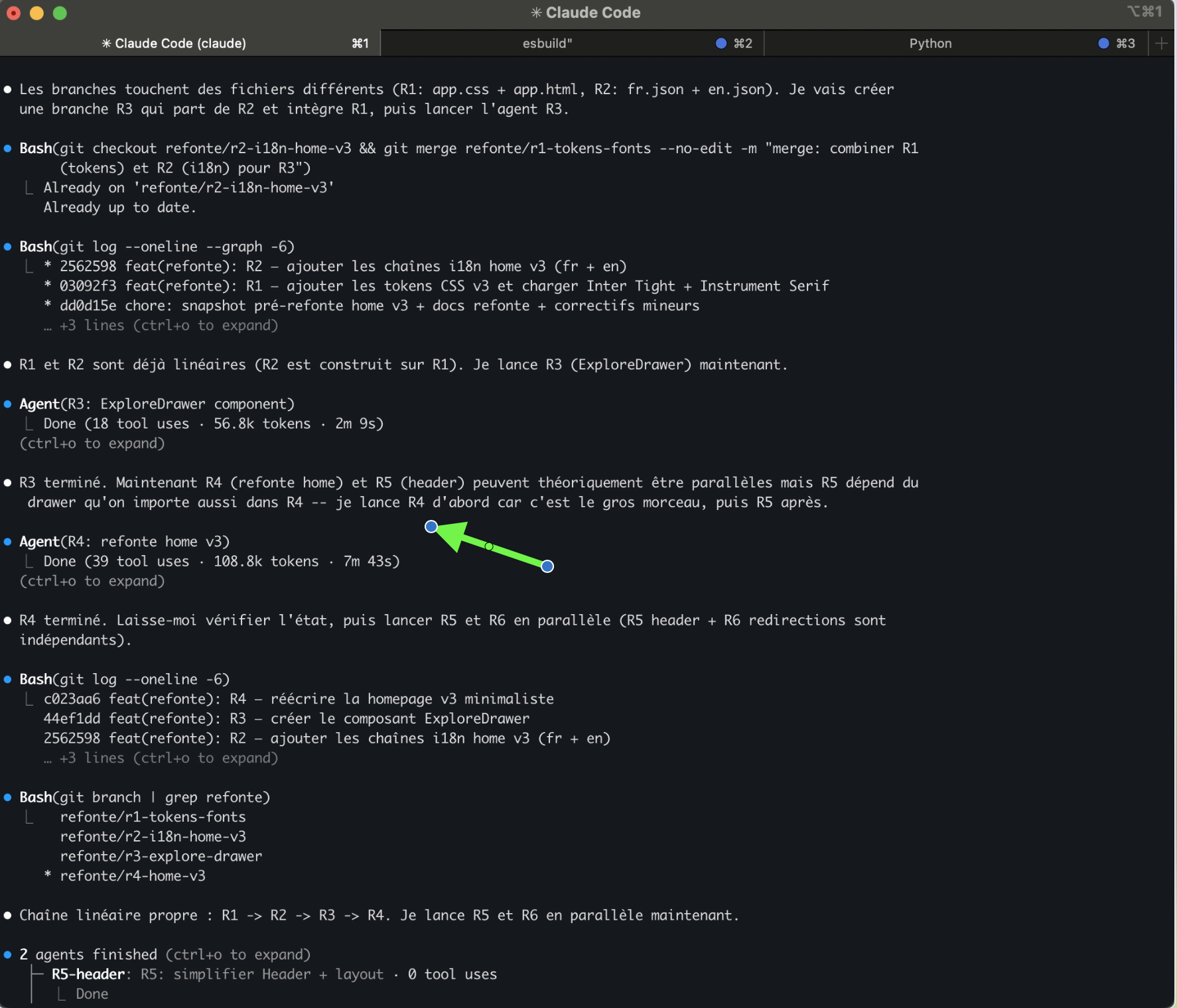
What you see: a terminal session managing multiple Git branches in parallel (refonte/r1-tokens-fonts, refonte/r2-i18n-home-v3, refonte/r3-explore-drawer, refonte/r4-home-v3), with Agent calls that each consumed between 18 and 39 tool uses, between 56,800 and 108,800 tokens, and between 2 and 8 minutes of execution. Each agent runs a sub-task, returns a result, and Claude Code merges the outputs into a coherent codebase.
What this is: a virtual engineering team working on six tickets in parallel, with explicit dependency management between branches, with Git history that I can read and audit at every step. Notice the cadence — "R1 et R2 sont déjà linéaires, je lance R3 maintenant... R3 terminé, je lance R4 d'abord car c'est le gros morceau... R4 terminé, je lance R5 et R6 en parallèle." That is not a chatbot. That is a senior engineer running a release plan.
[FIGURE 2 — Claude Design: project workspace with eleven home page iterations]
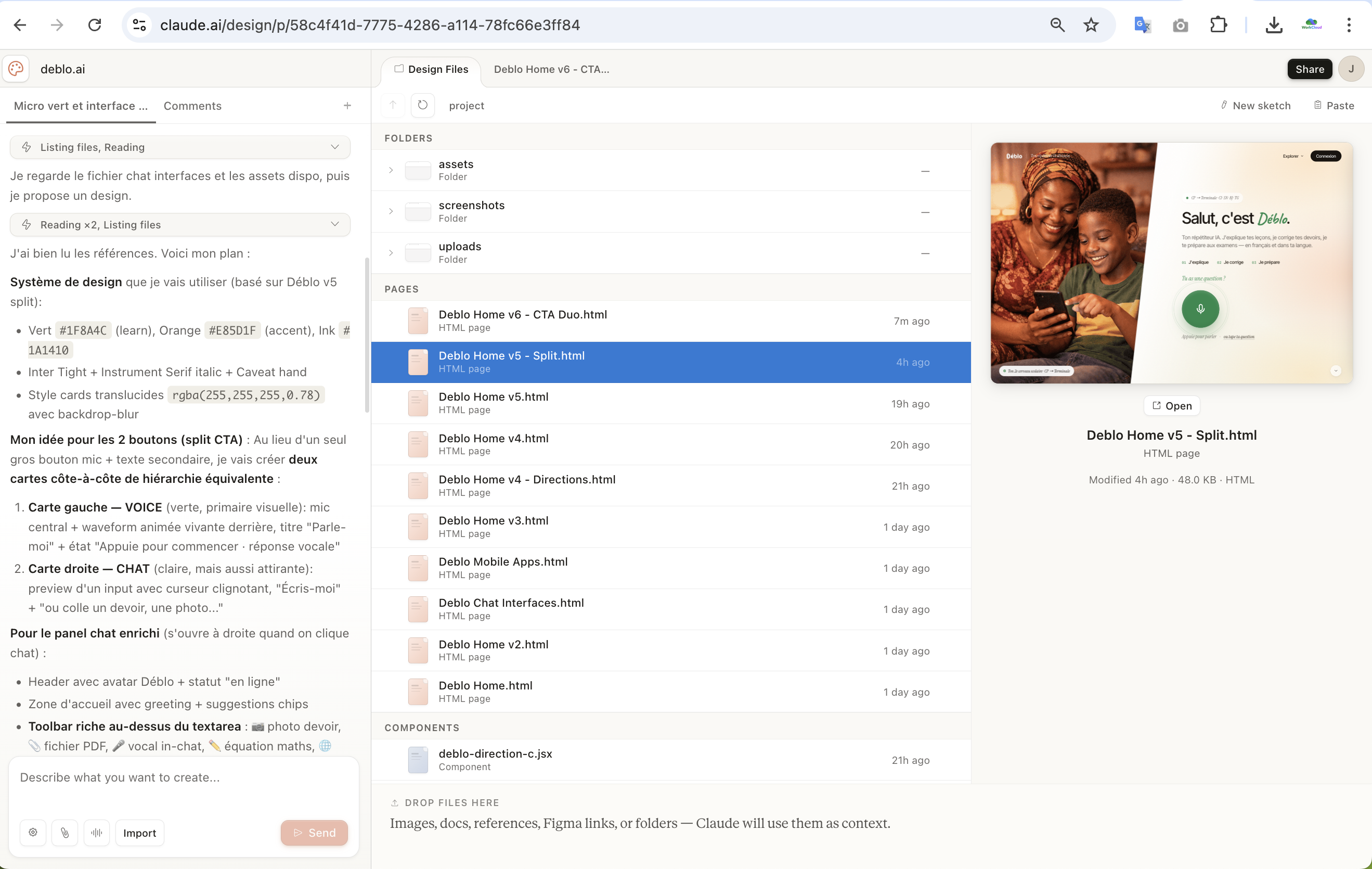
What you see: a design canvas with eleven page mockups (Deblo Home v2, v3, v4, v4 Directions, v5, v5 Split, v6 CTA Duo, plus mobile apps and chat interfaces), folder structure for assets / screenshots / uploads, and a component file (deblo-direction-c.jsx) that lives alongside the HTML pages. The right panel shows the V5 Split mockup that became the production home — the Ivorian mother and son photo on the left, the green microphone hero on the right.
What this is: a design partner that produces multiple visual iterations with explicit version control, file organization, and component reusability — same as a senior designer working in Figma, but in a chat-driven workflow with full file management.
[FIGURE 3 — Web Claude: this very strategic conversation]
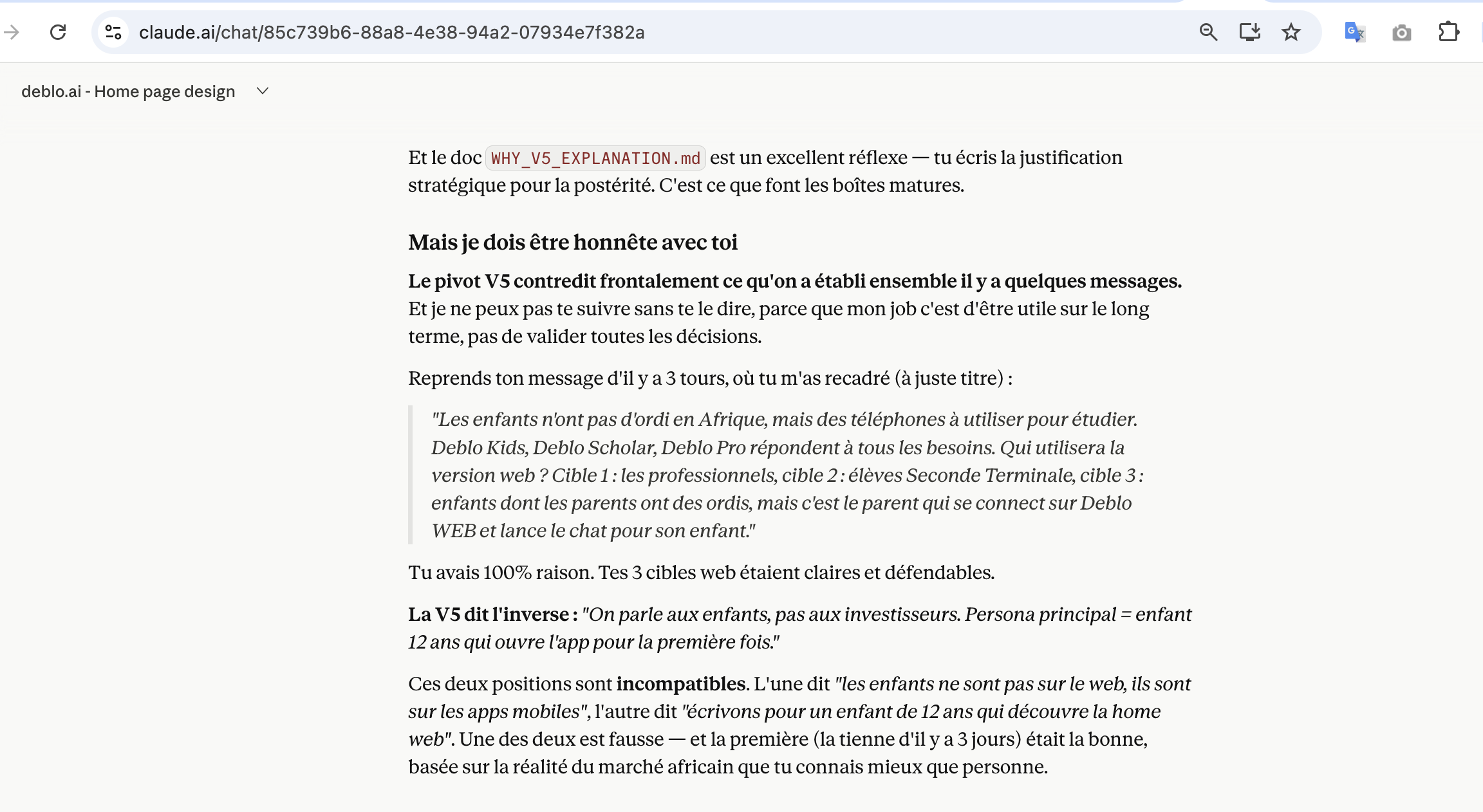
What you see: a long-form strategic dialogue, with quoted messages, italic emphasis, structured argumentation. The screenshot captures the exact moment when Web Claude pushed back on the V5 pivot — "Mais je dois être honnête avec toi. Le pivot V5 contredit frontalement ce qu'on a établi ensemble il y a quelques messages." — quoting back my own earlier message about African children not having computers, and explicitly declining to validate the pivot without a market signal to justify it.
What this is: a strategic advisor that holds multi-day context, references back to specific earlier exchanges, and is willing to disagree when the founder seems to be drifting — same as a senior consultant or co-founder, but available 24/7 and with no political stake in being right.
These three are not one tool
They are three different operational contexts, each with its own strengths, each requiring distinct skills to operate well.
When I run Claude Code for a refonte, I am writing structured prompts that include: - Explicit branch naming conventions for Git isolation - Dependency declarations between tickets ("R3 depends on R1 and R2") - Files to NOT touch (production code, working backend, existing routes) - Acceptance criteria that are specific enough to be testable - An ordering recommendation that minimizes regression risk
When I run Claude Design, I am providing: - Reference visuals from competitors and existing prod - Brand guidelines (Caveat handwriting for Déblo, Inter Tight body, color tokens) - Audience persona constraints - Output format expectations (HTML page that Claude Code can later port to Svelte)
When I run Web Claude (this conversation), I am providing: - Long-form strategic context with multiple iterations - Honest market data (the kind that triggered the "kids don't have computers" correction) - Permission to push back when my framing is wrong - Explicit role definition (strategic sparring partner, not decider)
This is not "talking to ChatGPT." This is operating a virtual team. The skill set required is closer to the skill set of a CTO managing three engineers than it is to the skill set of a hobbyist asking an AI to write code.
What this means for hiring decisions
If you are a CEO or CTO making AI-augmented hiring decisions in 2026, please understand this:
AI does not eliminate the need for product engineering skill. It elevates it.
A junior developer who asks ChatGPT to write a function gets a function. A senior product engineer who runs Claude Code with structured tickets, parallel agents, dependency graphs, Git branch isolation, and explicit acceptance criteria, gets a deployable feature. The quality gap between these two outcomes is not 10%. It is 10x. And that gap exists because of the skill of the operator, not despite it.
When I work with my Claude collaborators, I am not "using AI." I am running a virtual product team where:
- Web Claude is the strategic advisor and copywriter (this article, our Deblo positioning conversations, the SPEC documents, the copywriting packs)
- Claude Design is the lead designer (the v2 → v6 iterations, the mockup canvas, the component files)
- Claude Code is the senior engineer with multiple sub-agents at its disposal (the branch management, the parallel execution, the regression-safe commits)
- My Ultravox agent (Thales-Africa voice) is the deployed runtime persona that talks to children every day
These four "team members" coordinate around shared documents (SPEC.md, TASKS.md, COPY_PACK.md, the V5 HTML reference). Each one has its own context, its own job, its own quality bar. I am the founder coordinating them, providing the market knowledge they cannot have, making the strategic calls they should not make, and approving the work they ship.
This is enterprise-grade product development. Not a hobby. Not a weekend project. A multi-million dollar product staffed by a team of one human and four AI specialists, each with deep context and clear roles.
When I send a message to Claude Code, I am not asking a chatbot to please write some code. I am dispatching a multi-day work plan to an engineer who I have trained to my codebase conventions, my Git workflow, my regression risk tolerance, and my product strategy. That training takes hundreds of hours of careful prompt design, document maintenance, context curation, and iterative correction.
To developers reading this
If you are a developer feeling threatened by AI in 2026, here is the honest truth: the developers who feel threatened are the ones who use AI as a code completion tool. The developers who run AI as a virtual team are 10x more valuable than they were two years ago, and their compensation reflects it.
The skill is not "knowing how to prompt." The skill is knowing how to design a workflow where AI does what it is good at, humans do what they are good at, and the integration produces quality at scale. This is project management. This is system design. This is engineering leadership. These are the skills that scaled before AI, and they scale even more now.
If you are a CEO who wants to fire your developers because "AI does it now," you are about to learn a very expensive lesson. The companies that will dominate 2027 are not the ones with the cheapest AI-augmented teams. They are the ones with the best-trained AI-augmented teams, where every founder, every product manager, every engineer, every designer is operating their own virtual team of specialized AI collaborators.
Hiring stops being about replacing humans with AI. It starts being about hiring humans who can operate AI well. There is a difference. The difference is everything.
To the founders building in emerging markets
You have an advantage that San Francisco does not have: you understand markets that AI cannot understand on its own. Your ground-truth observations (children do not have computers, parents pay through Wave, students study in shared courtyards on phones) are competitive moats that no LLM training corpus contains.
Use AI to execute. Use yourself to position. Build virtual teams. Document everything. Treat your AI collaborators as serious team members with serious work products, not as toys.
And when the AI is confidently wrong, push back. Twice if you have to.
Conclusion
The home page that ships at deblo.ai today is the result of approximately 11 hours of strategic conversation, 7 hours of design iteration, and 14 hours of implementation across four parallel Git branches. Roughly 32 hours of work concentrated into 48 calendar hours, distributed across one human and four AI specialists.
The strategic correctness of the result depended on me catching two mistakes that AI made in good faith. The first mistake (ignoring that children do not have computers) was a market knowledge gap. The second mistake (accepting "broader audience" as default) was a competitive positioning gap. Neither would have been caught by AI on its own.
The execution quality of the result depended on AI doing what AI is excellent at: parallel branch management, multi-language i18n, accessibility audits, copy iteration, design exploration, technical specification authorship. None of this would have shipped in 48 hours with a traditional team.
The combination is the future of product engineering. Founders who understand this will build companies in 2026 that would have required 30-person teams in 2022. Founders who try to delegate strategy to AI, or who try to substitute AI for skilled execution partners, will ship products that miss their markets.
For Deblo, the lesson is now baked into how I work: strategy from the founder, execution from the team, correction loops in both directions, and a relentless commitment to remembering that I am building for Abidjan, not for Palo Alto.
On ne fait pas le poids against the giants if we play their game. But if we play our game — voice in our accent, curriculum in our system, payments in our currency, distribution in our channels — they cannot enter our weight class. That is the whole bet.
This piece was written collaboratively by Juste Thales Gnimavo (CEO of ZeroSuite, building Deblo and VeoStudio from Abidjan, Côte d'Ivoire) and Claude Opus 4.7 ADAPTIVE (web instance). The conversation it describes took place on April 24-26, 2026. The home page V5 referenced is live at https://deblo.ai. The three screenshots illustrating "Part 8 — A Critical Section for CEOs, CTOs, and Developers" show real working sessions: Claude Code managing parallel Git branches and sub-agents during the Deblo home refonte; Claude Design's project workspace with the V2 through V6 mockup iterations; and Web Claude's strategic conversation thread that produced this article. None of the work shown is a demo or a marketing setup. It is the actual workflow used to build a production product serving real African students every day.